Choosing the 2026 Best Hydraulic Actuator Factory requires more than comparing prices, brochures, or polished factory photographs. Global buyers need evidence from the workshop floor. They should examine machining accuracy, seal storage, pressure testing, traceability, and export experience. A dependable Hydraulic Actuator Factory should explain its process clearly, from steel inspection to final load testing.
M. Galal Rabie, a recognized fluid power engineer and author, offers a practical reminder: “A hydraulic actuator must be selected for its complete duty cycle, not pressure alone.” This principle matters in real applications. A cylinder rated for 160 bar may still fail under side loading, rapid cycling, poor alignment, or contaminated oil. The strongest suppliers discuss these risks before accepting an order.
Look closely.
A serious factory can provide test records, material certificates, dimensional reports, and replacement-part guidance. Ask how it verifies a 500-millimeter stroke, a welded joint, or a hard-chromed rod. Ask whether engineers review the installation environment. Salt air, freezing temperatures, dust, and long idle periods can change the specification.
The ideal supplier is not always the largest one. Sometimes, a smaller factory offers better communication and faster engineering changes. That choice still needs caution. Claims without independent evidence should not decide a purchase. Even experienced buyers can overlook maintenance access or delivery risks. A responsible evaluation compares technical capability, quality consistency, after-sales support, and documented performance. That is where confidence begins.
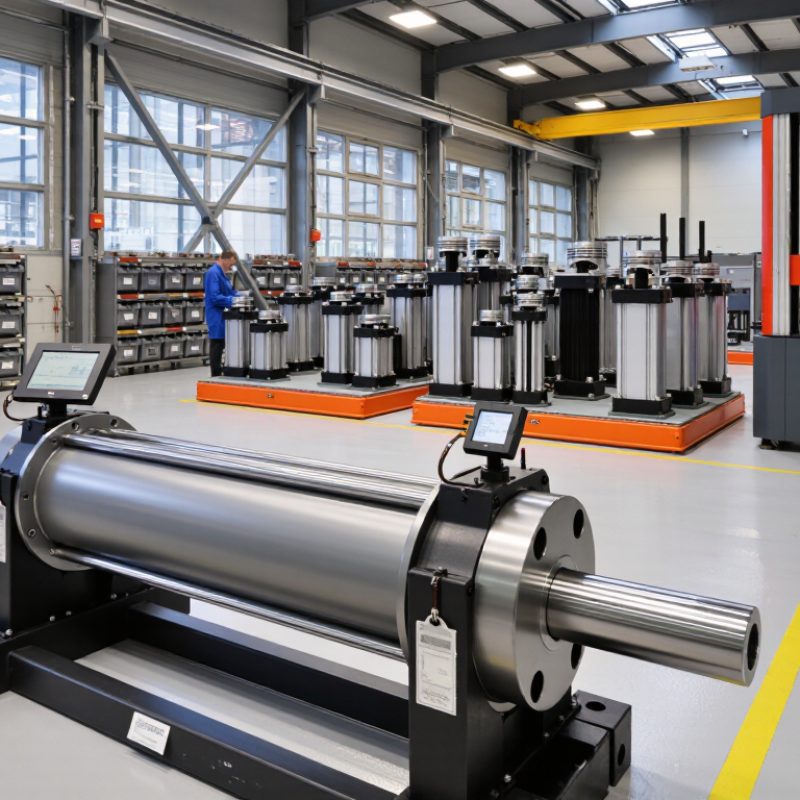
Hydraulic actuators convert pressurized fluid into controlled mechanical movement. A linear cylinder uses a barrel, piston, rod, seals, and fluid ports. When oil enters one side, pressure pushes the piston and extends the rod. Returning fluid leaves through the opposite port. Double-acting cylinders use pressure for both directions. Single-acting cylinders usually rely on a spring or external load for return movement.
The basic relationship is simple: force equals pressure multiplied by piston area. A larger piston can produce greater force, but it may move more slowly with the same flow rate. The pump creates flow, while valves control direction, speed, and pressure. A relief valve limits excessive pressure and helps protect the circuit. In practical testing, technicians check rod alignment, seal condition, fluid cleanliness, and mounting strength. Small alignment errors can cause uneven wear.
Operating conditions matter. Temperature changes fluid viscosity, and contaminated oil can damage tight valve clearances. The required stroke, load, cycle frequency, and installation space should be confirmed before production. A factory serving global buyers should document pressure tests, material data, sealing options, and inspection results. A clean diagram can mislead. Real machines experience vibration, side loads, and imperfect maintenance. That is why a reliable actuator design includes practical tolerances, accessible service points, and clear operating limits. Efficiency is useful, but predictable movement matters more.
Technical reference table for evaluating hydraulic actuator designs, operating characteristics, manufacturing requirements, and purchasing considerations. Values marked as typical depend on the specific design, material, sealing system, and application.
| Actuator Type | Basic Operating Principle | Main Motion | Typical Pressure Range | Typical Force or Torque Capability | Common Speed Range | Typical Applications | Key Selection Factors |
|---|---|---|---|---|---|---|---|
| Single-Acting Cylinder | Hydraulic pressure moves the piston in one direction; a spring, gravity, or external load returns the piston. | Linear | Approximately 70–250 bar, depending on design | Typically from several kilonewtons to more than 1,000 kN | Approximately 0.01–0.5 m/s | Jacks, lifting equipment, agricultural machinery, compact presses | Return-load arrangement, stroke length, mounting space, retraction force |
| Double-Acting Cylinder | Hydraulic pressure is supplied alternately to both sides of the piston for controlled extension and retraction. | Linear | Approximately 100–350 bar for many industrial systems | Typically from several kilonewtons to several thousand kilonewtons | Approximately 0.02–1.0 m/s | Construction machinery, machine tools, material handling, injection equipment | Bore and rod diameter, buckling resistance, side-load control, cushioning |
| Telescopic Cylinder | Two or more nested stages extend in sequence, providing a long stroke from a relatively short retracted length. | Linear | Approximately 140–350 bar, subject to stage design | Often from tens of kilonewtons to more than 1,000 kN | Approximately 0.02–0.5 m/s | Dump trucks, refuse vehicles, tipping platforms, mobile equipment | Collapsed length, stage synchronization, stability, load distribution, sealing |
| Tie-Rod Cylinder | A piston and rod assembly operates inside a barrel held together by external tie rods and end caps. | Linear | Commonly 70–210 bar; higher ratings are available in specialized designs | Typically several kilonewtons to hundreds of kilonewtons | Approximately 0.02–0.75 m/s | Factory automation, packaging machines, agricultural equipment | Serviceability, standard dimensions, mounting method, corrosion protection |
| Welded Cylinder | A welded body contains the piston, rod, seals, and hydraulic ports; the compact construction supports demanding mobile applications. | Linear | Commonly 140–350 bar; application-specific designs may differ | Typically several kilonewtons to several thousand kilonewtons | Approximately 0.02–1.0 m/s | Mining, mobile hydraulics, forestry, earthmoving, heavy-duty equipment | Weld quality, fatigue life, rod coating, contamination protection, pressure rating |
| Rotary Hydraulic Actuator | Hydraulic pressure acts on vanes, pistons, or a helical mechanism to produce rotary movement and torque. | Rotary | Approximately 70–350 bar, depending on mechanism | From tens of newton-metres to several hundred thousand newton-metres | Typically 5–300 rpm | Valve operation, indexing systems, excavator attachments, material positioning | Required angle, torque, shaft load, backlash, rotation speed, duty cycle |
| Servo Hydraulic Actuator | A hydraulic power stage is controlled by a servo or proportional valve, often with position, force, or velocity feedback. | Linear or rotary | Approximately 70–350 bar, according to the system design | From precise low-force control to very high industrial loads | Application-specific; high dynamic response is possible | Test systems, metal forming, flight simulation, precision motion control | Feedback resolution, valve response, oil cleanliness, control bandwidth, thermal management |
| Evaluation Dimension | What Global Buyers Should Check | Why It Matters | Recommended Technical Evidence |
|---|---|---|---|
| Load and Force Calculation | Confirm required load, external forces, acceleration, friction, and safety factor before selecting bore and rod dimensions. | Hydraulic force is approximately pressure multiplied by piston area; retraction force is reduced by the rod area. | Approved load calculations, cylinder sizing sheet, pressure and force test records |
| Pressure Rating | Differentiate between rated working pressure, proof pressure, and burst pressure. | Operating above the rated pressure can shorten fatigue life and increase the risk of leakage or structural failure. | Pressure rating declaration, hydrostatic proof-test procedure, material and design documentation |
| Stroke and Geometry | Specify stroke, retracted length, extension length, mounting dimensions, and allowable misalignment. | Incorrect geometry can cause interference, excessive side loading, piston-rod buckling, or insufficient movement. | Dimensioned drawings, 3D CAD files, tolerance chart, installation interface drawing |
| Rod and Barrel Materials | Review material grade, heat treatment, surface hardness, chrome or alternative coating, and internal barrel finish. | Material and surface quality influence fatigue resistance, wear, corrosion performance, and seal life. | Material certificates, hardness reports, coating thickness records, surface-finish measurements |
| Sealing System | Match seal compounds and profiles to pressure, temperature, fluid type, speed, and contamination conditions. | Seal compatibility is essential for preventing internal bypass, external leakage, and premature maintenance. | Seal material specifications, temperature range, compatibility statement, leakage test results |
| Hydraulic Fluid Compatibility | Identify the exact fluid, viscosity range, temperature range, cleanliness level, and additives used in the system. | Mineral oils, biodegradable fluids, water-glycol fluids, and fire-resistant fluids may require different sealing materials. | Fluid compatibility matrix, recommended viscosity range, installation and maintenance instructions |
| Manufacturing Quality Control | Check machining accuracy, welding controls, cleanliness, assembly procedures, and traceability of critical components. | Consistent process control reduces dimensional variation, contamination-related failures, and batch-to-batch performance differences. | Inspection plan, weld procedure records, cleanliness report, serial-number traceability |
| Testing and Validation | Verify pressure, leakage, stroke, speed, load, endurance, and functional performance under representative conditions. | Testing confirms whether the actuator meets the intended duty cycle rather than only its static design specification. | Factory acceptance test report, endurance-test data, pressure-hold results, dimensional inspection report |
| Environmental Protection | Consider dust, water, salt spray, temperature, impact, vibration, and outdoor storage conditions. | Environmental exposure affects coatings, seals, rod surfaces, electrical sensors, and service intervals. | Coating specification, corrosion-test data where applicable, environmental operating limits |
| Documentation and Export Readiness | Request drawings, bills of materials, installation instructions, spare-parts information, packaging details, and applicable conformity documents. | Complete documentation supports installation, customs processing, maintenance, and future replacement. | Technical datasheet, user manual, packing list, inspection certificate, declaration of conformity where required |
Note: Hydraulic actuator performance depends on pressure, flow rate, load direction, mounting alignment, fluid cleanliness, temperature, and duty cycle. The ranges shown are general engineering reference values and should be confirmed against the final actuator drawing and application requirements.