2026 Best Tile Laser Cutting Machine for Global Buyers

Choosing the 2026 Best Tile Laser Cutting Machine requires more than comparing wattage. Global buyers must examine ceramic hardness, tile thickness, edge quality, automation, safety systems, and local service support. A glossy brochure cannot reveal how a machine performs after eight hours of continuous cutting.

Industry data shows why this decision matters. Fortune Business Insights estimates that the global ceramic tiles market will continue expanding through 2032, supported by housing, commercial construction, and renovation demand. Meanwhile, MarketsandMarkets projects strong growth for the laser cutting machine market through 2029, driven by automation and higher production accuracy. These reports indicate a larger opportunity, but they do not guarantee that every Tile Laser Cutting Machine suits every factory.

Performance depends on process control. John Powell, author of CO2 Laser Cutting, has emphasized, “A laser is only as good as the process around it.” That principle remains practical in 2026. A stable ceramic tile can still crack when focus, speed, cooling, or support is poorly adjusted. Small details matter. Dust can cloud optics. Uneven tables can create chipped corners. After-sales support may matter more than peak power.

This guide compares leading machines for international buyers. It considers cutting precision, operating cost, software, maintenance, installation, and supplier reliability. Some conclusions remain imperfect because manufacturers publish different test conditions. Buyers should request sample cuts before purchasing. That extra step may prevent an expensive mistake.
2026 Best Tile Laser Cutting Machine for Global Buyers

What a Tile Laser Cutting Machine Is and How It Works

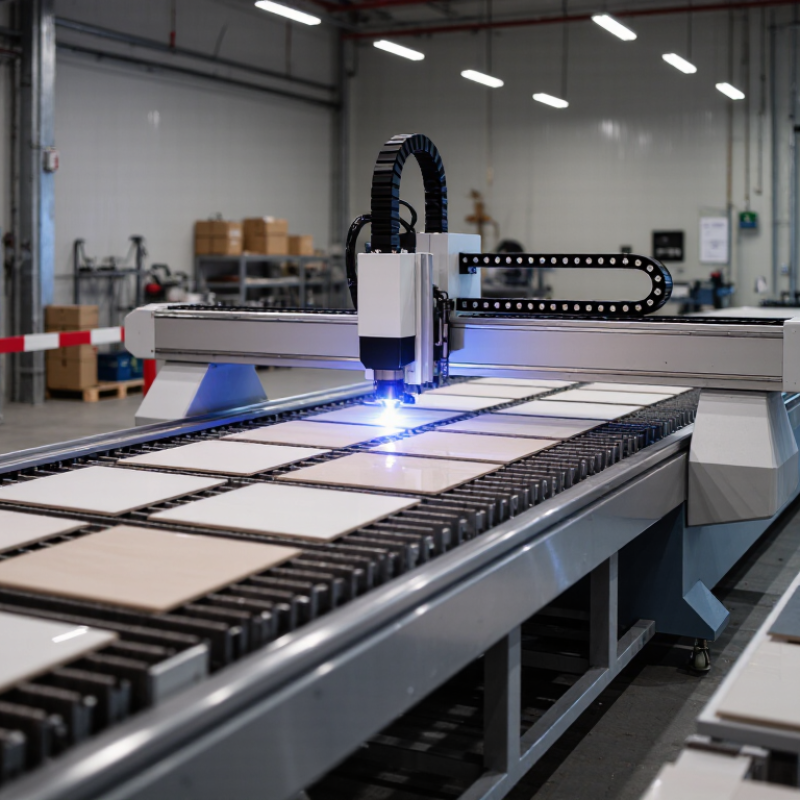
A tile laser cutting machine uses a focused light beam to remove material along a programmed path. Unlike a mechanical blade, it does not need direct contact with the tile surface. The laser head concentrates energy into a tiny spot, creating heat that melts, vaporizes, or fractures selected ceramic, porcelain, or stone areas. Air or nitrogen can remove debris from the cut zone. The result is a narrow kerf and detailed shapes.

The workflow is practical. An operator loads a digital drawing into the control system, secures the tile on a flat bed, and sets power, speed, focus, and gas pressure. A camera may locate printed patterns or edge defects. The machine then follows the design line by line. Curves, holes, mosaics, and narrow strips become possible. Dry cutting also reduces water use, although dust extraction remains essential.

Market data explains the growing interest. Grand View Research estimates the global laser cutting machine market at roughly US$5 billion in 2023, with continued growth expected through 2030. ACIMAC’s Ceramic World Review 2024 reported global tile production near 16.7 billion square metres in 2023. Those figures suggest strong industrial demand, but they do not guarantee quick returns. Reporting methods differ. Cutting performance also changes with glaze, thickness, and tile tension. In real workshops, a perfect sample can still fail after production begins. Test several batches, inspect chipped edges, and measure the finished part before approving large orders.

Key Features to Compare When Choosing a Tile Laser Cutter

2026 Best Tile Laser Cutting Machine for Global Buyers

Key Features to Compare When Choosing a Tile Laser Cutter

Global demand is pushing buyers toward faster, cleaner tile processing. MarketsandMarkets valued the laser cutting machine market at about USD 6.8 billion in 2023. Its forecast also indicates continued growth through 2028. This figure covers many industries, not tiles alone. Still, it shows why equipment comparisons need practical evidence. Check laser power, cutting speed, beam stability, and positioning accuracy. A higher wattage is not automatically better. For glazed porcelain, excessive heat may create chipped edges or dark marks. A stable cooling system matters more than impressive power figures. Bed size should also match common tile formats, including large slabs.

Look closely at kerf width and repeatability. A 0.1-millimeter error can become visible around a bathroom niche. Test the machine with your own tile samples. Ask for measured results, not only catalogue claims. Software should import common CAD files and support irregular shapes. Dust extraction, enclosed operation, emergency stopping, and electrical certification deserve equal attention. The 2024 Fortune Business Insights report identifies construction activity as a major ceramic tile market driver. That suggests reliability and service access may influence returns more than peak speed.

Tips: Request a sample cut before purchase. Inspect the edge under bright light. Compare power consumption, lens replacement, cooling maintenance, training, and spare-part delivery. Keep a written test record. It exposes weak assumptions. Industry reports are useful, but they cannot replace a workshop trial.

Best Tile Materials and Designs for Laser Cutting

2026 Best Tile Laser Cutting Machine for Global Buyers

Best Tile Materials and Designs for Laser Cutting

Porcelain and dense ceramic tiles suit precision laser work best. Their uniform bodies support clean geometric patterns and repeatable production. Grand View Research estimated the global ceramic tiles market at about USD 227 billion in 2023, with strong growth through 2030. That scale reflects demand for customized surfaces, not only standard flooring.

Choose a CO2 laser system with stable cooling, adjustable power, and accurate motion control. CO2 wavelengths interact more effectively with many nonmetallic materials than fiber systems. Glass tile can produce elegant frosted lines, but heat may create edge chips. Natural stone offers dramatic variation, although moisture, veins, and uneven thickness complicate focusing. Test every batch.

Small samples matter.

Popular designs include ventilation-like perforations, terrazzo-inspired inlays, botanical silhouettes, and thin border grids. For glazed tiles, lower power with multiple passes can reduce discoloration. Porcelain usually needs slower movement or higher energy, depending on thickness and finish. The Tile Council of North America’s technical guidance emphasizes substrate stability and movement accommodation; a beautiful cut can still fail after installation.

In practice, I would question any machine promising identical results across every tile. That claim sounds attractive, but glaze chemistry changes unexpectedly. Buyers should request cut samples, dimensional tolerances, extraction specifications, and safety documentation before purchase. A 0.5-millimeter error may seem minor, yet it becomes obvious across a long kitchen backsplash.

How to Select Machine Power, Size, and Automation

For a 2026 tile laser cutting machine, power should follow tile composition, thickness, and required edge quality. Porcelain, glazed ceramic, and stone-effect slabs react differently to heat. Do not choose power from catalog speed alone. Request test cuts using your actual 600×600 mm or 1200×600 mm tiles. Check chipping, discoloration, kerf width, and repeatability. A lower-power system may suit decorative cutting, while thicker porcelain demands stronger output, better cooling, and slower acceleration.

Size should match your real workpieces, not your largest possible order. A larger bed increases flexibility but also raises floor space, extraction, and maintenance costs. Automation matters when batches repeat. Automatic loading, vision positioning, height sensing, and conveyor handling can reduce alignment errors. The International Federation of Robotics reported 541,302 industrial robots installed worldwide in 2023, showing how quickly automated production is expanding. Yet automation is not automatically economical. Small workshops may recover faster from reliable positioning than from a fully robotic line.

Ask suppliers for measured cycle times, electrical consumption, laser-source life, and service response records. The International Energy Agency’s Energy Efficiency 2024 analysis reinforces a practical point: efficiency improvements must be measured in operating conditions, not promised on paper. I would also inspect dust extraction and thermal control. These details are easy to overlook. My own selection rule is still imperfect: buy the smallest system that passes your worst material test, then leave room for future automation.

2026 Best Tile Laser Cutting Machine for Global Buyers - How to Select Machine Power, Size, and Automation

Reference configurations for ceramic, porcelain, stone, glass, and metal tile processing. Actual performance depends on material composition, thickness, coating, cutting pattern, and process settings.

Configuration Profile Recommended Materials Laser Type Rated Power Effective Working Area Typical Material Thickness Positioning Accuracy Maximum Travel Speed Automation Level Best Use Case Utility Requirement
Compact Precision Tile Cutter Small ceramic tiles, porcelain samples, glass mosaics CO₂ laser 150–300 W 1,000 × 600 mm Up to 8 mm ±0.05 mm 600 mm/s Semi-automatic Prototype work, decorative patterns, laboratories, and small workshops Single-phase power; closed-loop water chiller; extraction system
Standard Ceramic Production Cutter Porcelain, glazed ceramic, engineered stone, coated tile CO₂ laser 300–600 W 1,300 × 2,500 mm Up to 12 mm ±0.08 mm 800 mm/s Semi-automatic General-purpose production of straight cuts, slots, and logos Three-phase power; temperature-controlled chiller; fume filtration
Large-Format Architectural Tile Cutter Large porcelain slabs, ceramic panels, stone-composite panels CO₂ laser 600–1,000 W 1,500 × 3,000 mm Up to 20 mm ±0.10 mm 800 mm/s Automatic height sensing Large-format wall panels, flooring layouts, and architectural projects Three-phase power; industrial chiller; high-capacity extraction
High-Throughput Tile Processing Cell Continuous ceramic and porcelain tile production CO₂ laser 600–1,000 W 1,500 × 3,000 mm Up to 15 mm ±0.10 mm 800–1,000 mm/s Fully automatic High-volume cutting with conveyor loading, unloading, and nesting Three-phase power; conveyor integration; centralized extraction and chiller
Metal Tile and Roofing Panel Cutter Aluminum, galvanized steel, stainless steel, and coated metal tiles Fiber laser 2–6 kW 1,500 × 3,000 mm Carbon steel up to 12 mm; stainless steel up to 6 mm ±0.03 mm 1,200–2,000 mm/s Automatic nesting Metal roofing tiles, façade panels, decorative sheets, and brackets Three-phase power; compressed air or nitrogen; fiber-laser dust extraction
Heavy-Duty Industrial Panel Cutter Thick metal panels and reinforced architectural components Fiber laser 6–12 kW 2,000 × 4,000 mm Carbon steel up to 25 mm; stainless steel up to 12 mm ±0.05 mm 1,000–1,500 mm/s Optional loading automation Heavy-gauge metal tile production and large structural panels Three-phase power; high-pressure assist gas; industrial chiller and extraction
Vision-Guided Decorative Tile Cutter Printed ceramic tiles, patterned porcelain, glass, and mosaic sheets CO₂ laser 150–400 W 1,300 × 2,500 mm Up to 10 mm ±0.05 mm with vision correction 500–700 mm/s Vision-assisted Pattern alignment, irregular contours, inlays, and decorative designs Stable power supply; camera system; chiller; filtered extraction
Selection guide: Choose lower-power CO₂ systems for thin non-metallic tiles and decorative work; select higher-power CO₂ systems for thicker ceramic or porcelain panels; choose fiber-laser systems for metal tiles. For production above approximately 100–200 panels per shift, consider automatic loading, unloading, nesting, and conveyor integration.

Global Buying Factors: Safety, Compliance, Service, and Cost

For global buyers, selecting the best tile laser cutting machine in 2026 requires more than comparing cutting speed. Safety should be examined during a factory demonstration. Look for a sealed working area, door interlocks, an emergency stop, and effective fume extraction. Suitable laser protection must match the machine’s wavelength. Operators also need practical training, not only a translated manual. Safety comes first.

Compliance can become difficult across borders. Ask for electrical test reports, laser classification details, risk assessments, and clear operating instructions. Confirm whether the machine suits your country’s voltage, plug system, workplace rules, and import requirements. Local authorities may request additional documents. A missing certificate can delay installation. Do not assume one approval covers every market.

Service quality strongly affects real operating cost. Request installation support, calibration guidance, spare-parts availability, and a defined response time for technical problems. Remote help is useful, but complex faults may require an engineer. Compare power consumption, lens replacement, cooling needs, maintenance labor, and expected downtime. The cheapest quotation may hide expensive interruptions.

I would also test cutting accuracy on your own tile samples, because advertised results can look better than daily production. A careful buyer should accept that no machine fits every tile type perfectly. That limitation deserves honest discussion before payment.

Stay in touch with the latest National Luna Products and News!