Choosing the right Rs422 To Ethernet converter is rarely as simple as comparing port counts or advertised speeds. Global buyers often work with older PLCs, barcode scanners, motion controllers, and field instruments that still depend on stable RS422 communication. The converter must bridge those signals without weakening timing, isolation, or data integrity.
Jan Axelson, author of Serial Port Complete, explains, “RS-422 uses differential signaling for improved noise immunity.” That principle remains important in factories with long cable runs, variable-frequency drives, and electrically noisy control cabinets. In practice, a DIN-rail converter with galvanic isolation may suit a production line better than a compact desktop model. A cloud-connected gateway may help remote monitoring, but it can add configuration risks.
Small details matter. Check baud-rate support, termination settings, connector design, operating temperature, and Ethernet management features. Verify whether the unit supports TCP server, TCP client, UDP, or virtual COM operation. These functions are not interchangeable. They affect software compatibility and maintenance time.
There is no universal winner. A low-cost converter can perform well in a clean laboratory, yet fail expectations beside a motor inverter. I have seen specifications look impressive while installation guidance remained vague. That should encourage careful review, not blind confidence. Regional certifications, warranty response, firmware stability, and replacement availability also influence total ownership cost.
This guide compares major Rs422 To Ethernet Converter types for global buyers. It focuses on real deployment conditions, not only catalog claims. Some conclusions may remain conditional, because network architecture and field noise can change the result.
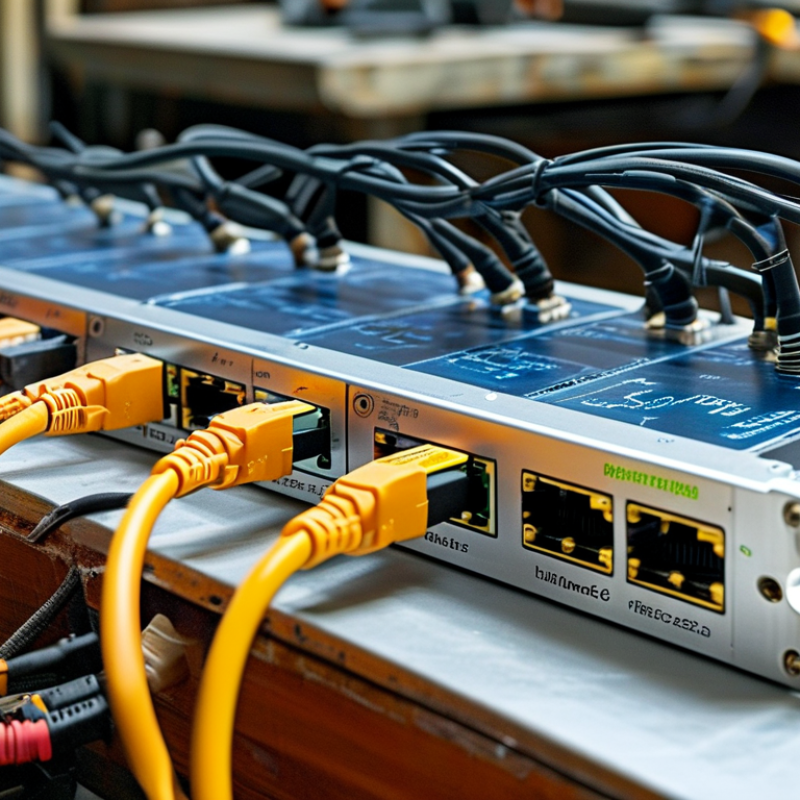
Top RS422 to Ethernet Converter Types for Global Buyers
An RS422 to Ethernet converter links legacy serial equipment with modern IP networks. It receives balanced differential signals, then packages their data for TCP or UDP communication. RS-422 supports longer cable runs and better noise resistance than ordinary single-ended serial links. That matters near motors, inverters, and factory panels.
In practical installations, buyers usually choose three types. A basic point-to-point converter suits one controller and one remote device. A multiport serial server supports several instruments through one network connection. An industrial model adds wide-temperature operation, galvanic isolation, surge protection, and dual power inputs. The correct choice depends on baud rate, connector wiring, termination, and required Ethernet protocol. An RJ45 port alone proves very little.
HMS Networks’ 2024 Industrial Network Market Shares report found Industrial Ethernet represented 71% of newly installed industrial network nodes. That figure explains the migration pressure, but it does not make every converter suitable. TIA-422-B remains important for checking electrical interface behavior, while field tests should verify cable length and grounding. I have seen projects fail because engineers checked software settings but ignored signal termination. A converter can support TCP perfectly and still lose characters. That is an uncomfortable detail. Global buyers should also confirm regional power requirements, enclosure ratings, and cybersecurity controls before deployment.
| Converter Type | What It Does | RS-422 Interface | Network Interface | Typical Data Rate | Typical Cable Reach | Recommended Application |
|---|---|---|---|---|---|---|
| Basic Single-Port Converter | Encapsulates RS-422 serial data into Ethernet packets and converts received network data back to RS-422. | 4-wire, full-duplex differential interface; commonly uses terminal blocks or a serial connector. | 10/100 Mbps Ethernet, usually copper RJ45. | Up to 1 Mbps is common; the achievable rate depends on cable length and converter design. | RS-422 segments can reach up to approximately 1,200 m at lower data rates; copper Ethernet is normally up to 100 m per segment. | Remote monitoring, laboratory equipment, controllers, and general serial-to-network access. |
| Industrial-Grade Converter | Provides serial networking in industrial environments with a rugged enclosure and wider operating-temperature capability. | RS-422 full-duplex differential signaling with screw-terminal or industrial connector options. | 10/100 Mbps Ethernet; some models support gigabit Ethernet. | Commonly up to 1 Mbps, subject to the serial interface specification. | Up to about 1,200 m for RS-422 at low speed; up to 100 m for standard twisted-pair copper Ethernet. | Factory automation, traffic systems, energy equipment, and control cabinets. |
| Electrically Isolated Converter | Separates the serial and network-side electrical grounds to reduce ground-loop current and improve protection against transients. | Isolated RS-422 differential input and output; isolation voltage varies by model. | 10/100 Mbps Ethernet is typical. | Usually supports common RS-422 rates from low-speed operation to approximately 1 Mbps. | Distance follows the RS-422 cable and Ethernet segment limits; isolation does not itself extend cable reach. | Long cable runs, outdoor equipment, separate power domains, and electrically noisy installations. |
| Multi-Port Serial Device Server | Connects several independent RS-422 devices to one IP network for centralized access and management. | Typically 2, 4, 8, or more RS-422 ports; port configuration is often software-selectable. | 10/100 Mbps or 10/100/1000 Mbps Ethernet, depending on the unit. | Per-port performance varies; many installations use rates from 9.6 kbps to 1 Mbps. | Each RS-422 port may support up to approximately 1,200 m at lower data rates; Ethernet distance depends on the LAN design. | SCADA systems, building automation, test benches, and centralized equipment management. |
| RS-422 to Ethernet Fiber Converter | Transports RS-422 data over an optical fiber link for extended distance and immunity to electromagnetic interference. | 4-wire, full-duplex RS-422 serial connection. | Fiber Ethernet through a dedicated optical transceiver or SFP-based interface. | Serial rates commonly range from low-speed operation to approximately 1 Mbps. | Multimode fiber may cover hundreds of meters; single-mode fiber can cover several kilometers or more, depending on optics and network design. | Railways, substations, campuses, mines, and links between buildings. |
| DIN-Rail Mounted Converter | Uses a compact enclosure designed for installation inside control panels and electrical cabinets. | RS-422 4-wire full-duplex interface with industrial wiring terminals. | Usually 10/100 Mbps copper Ethernet; some versions include fiber uplinks. | Typically supports standard serial rates up to approximately 1 Mbps. | RS-422 up to approximately 1,200 m at lower speeds; copper Ethernet generally up to 100 m per segment. | PLC panels, industrial gateways, machine tools, and distributed control systems. |
| Managed Network Converter | Adds network-management functions such as remote configuration, diagnostics, access control, and event monitoring. | One or more RS-422 ports, normally configurable through a web interface or network-management tools. | 10/100 Mbps or gigabit Ethernet with TCP/IP and commonly UDP support. | The serial port remains limited by its configured RS-422 baud rate; Ethernet bandwidth is normally not the limiting factor. | Local Ethernet segments are typically limited to 100 m over copper, while routed networks can span much farther. | Critical infrastructure, remote service networks, and installations requiring centralized diagnostics. |