7 Best Spa Chillers for Commercial Pools in 2026

Commercial pool cooling is no longer a luxury feature. It is becoming a practical operating decision. The International SPA Association’s 2024 U.S. Spa Industry Study reported $21.1 billion in annual spa revenue and 187 million visits in 2023. That demand puts pressure on operators to maintain stable water temperatures, even during crowded summer sessions.

The Global Wellness Institute also valued the global wellness economy at $6.3 trillion in 2023. However, market growth does not make every cooling system suitable. Pool size, heat gain, humidity, circulation rate, noise, and installation space can change the result dramatically. A compact rooftop spa may need a different Spa Chiller from a 50,000-gallon resort pool.

Aquatic HVAC specialist Mike Holtz explains the core principle clearly: “A chiller must remove heat faster than the pool gains it.” That sounds simple. It is not.

This guide examines seven leading Spa Chiller options for commercial pools in 2026. Each choice is considered through cooling capacity, energy performance, controls, corrosion resistance, service access, and total ownership cost. A low purchase price can look attractive beside a pool deck. It may become expensive after repeated maintenance calls.

No ranking is perfect. Manufacturer data often uses different testing conditions, which makes direct comparison difficult. Real-world performance can also change with sunlight, bather loads, and poor water chemistry. These recommendations therefore combine published specifications, industry reports, and practical operating concerns. Operators should still verify heat-load calculations before purchasing.
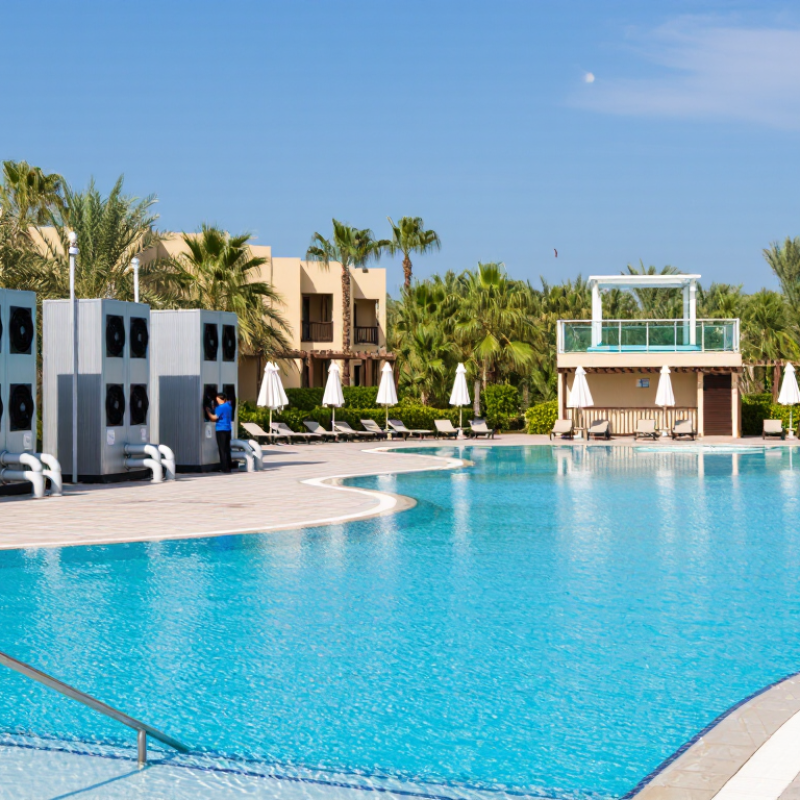
7 Best Spa Chillers for Commercial Pools in 2026

Commercial Spa Chiller Criteria: CDC’s 104°F Maximum Water Temperature

Choosing among the 7 best spa chillers for commercial pools in 2026 starts with temperature control. CDC guidance identifies 104°F as the maximum water temperature for hot tubs and spas. This limit helps reduce overheating risks, especially during crowded operating hours. However, local health codes may be stricter. Operators should confirm requirements before selecting equipment.

A commercial chiller should maintain stable water temperature, not simply cool the tank after overheating occurs. Look for accurate digital sensors, adjustable set points, automatic shutdown protection, and sufficient flow capacity. A busy spa can gain heat quickly from sunlight, pumps, body contact, and warm air. A unit that performs well in a quiet test may struggle at 6 p.m.

Measure the real load.

During site evaluation, record water volume, turnover rate, ambient temperature, and peak bather count. Use corrosion-resistant materials when chemicals are continuously present. Service access also matters; blocked filters can reduce cooling performance within hours. My early equipment comparisons focused too heavily on cooling capacity. That was incomplete. Control accuracy and recovery time often affect daily safety more than a larger headline rating. Keep calibrated thermometers and temperature logs, even with automated controls. Sensors can drift. People make mistakes. A clear manual override and staff training can prevent small errors from becoming dangerous conditions.

7 Best Spa Chillers for Commercial Pools in 2026

Commercial Spa Chiller Criteria: CDC’s 104°F Maximum Water Temperature

Rank Commercial Chiller Profile Nominal Cooling Class Cooling Capacity Indicative Spa Volume Recommended Design Flow Best Application Important Selection Criteria
1 Compact Variable-Speed Chiller 0.5 refrigeration ton 6,000 BTU/h
1.76 kW of cooling
500–1,000 US gal
1,900–3,800 L
10–20 GPM
38–76 L/min
Small therapy spas, private treatment rooms, and low-bather-load commercial facilities.
  • Variable-speed compressor or fan
  • Titanium or corrosion-resistant heat exchanger
  • Flow switch and high-temperature alarm
2 Standard Single-Circuit Spa Chiller 1 refrigeration ton 12,000 BTU/h
3.52 kW of cooling
1,000–2,000 US gal
3,800–7,600 L
15–30 GPM
57–114 L/min
Hotel spas, fitness clubs, and moderate-use hydrotherapy pools.
  • Digital temperature controller
  • Continuous-duty circulation compatibility
  • Automatic restart after power interruption
3 High-Efficiency 1.5-Ton Chiller 1.5 refrigeration tons 18,000 BTU/h
5.28 kW of cooling
1,500–3,000 US gal
5,700–11,400 L
20–40 GPM
76–151 L/min
Busy hotel spas and commercial therapy pools exposed to frequent bather loads.
  • High seasonal efficiency
  • Low-ambient operating protection
  • Adjustable set point and anti-freeze protection
4 Heavy-Duty 2-Ton Chiller 2 refrigeration tons 24,000 BTU/h
7.03 kW of cooling
2,000–4,000 US gal
7,600–15,100 L
25–50 GPM
95–189 L/min
Large commercial spas, aquatic therapy centers, and facilities with long operating hours.
  • Commercial-duty compressor
  • Replaceable water-side components
  • Remote fault contacts for building management systems
5 Dual-Circuit Redundant Chiller 2 × 1 refrigeration ton 24,000 BTU/h total
7.03 kW of cooling
2,000–4,000 US gal
7,600–15,100 L
25–50 GPM
95–189 L/min
Healthcare hydrotherapy, rehabilitation, and high-availability commercial facilities.
  • Independent refrigeration circuits
  • Partial-capacity operation during service
  • Separate pressure and temperature safeties
6 Large-Volume Modular Chiller 3 refrigeration tons 36,000 BTU/h
10.55 kW of cooling
3,000–6,000 US gal
11,400–22,700 L
35–70 GPM
132–265 L/min
Large resort spas, multi-zone wellness facilities, and high-throughput therapy areas.
  • Modular installation capability
  • Balanced water distribution across multiple zones
  • Service isolation valves and accessible filters
7 Central Plant Scroll Chiller 5 refrigeration tons 60,000 BTU/h
17.59 kW of cooling
5,000–10,000 US gal
18,900–37,900 L
50–100 GPM
189–379 L/min
Large aquatic centers, multiple connected spas, and commercial facilities requiring centralized water treatment.
  • Lead-lag sequencing for multiple compressors
  • Building automation integration
  • Flow balancing, water-quality monitoring, and emergency shutdown controls
Planning note: The CDC identifies 104°F as the maximum water temperature for hot tubs and spas. The capacity and pool-volume ranges above are preliminary sizing classes, not guaranteed performance ratings. Final selection should be based on a site-specific heat-load calculation that considers water volume, starting temperature, desired pull-down time, ambient temperature, solar gain, cover usage, humidity control, bather load, circulation rate, and applicable local codes.

Sizing Chillers with 500 Btu per Pound of Water Evaporation

7 Best Spa Chillers for Commercial Pools in 2026

Sizing a commercial spa chiller starts with evaporation, not equipment horsepower. A useful screening method assigns 500 Btu for every pound of water evaporated per hour. For example, 40 pounds per hour creates a preliminary load of 20,000 Btu/h. That equals approximately 1.67 tons of cooling.

The number needs careful interpretation. ASHRAE’s HVAC Applications Handbook places water evaporation near 1,000 Btu per pound under typical pool conditions. Therefore, the 500 Btu shortcut may underestimate the latent load. It can still support early comparisons, but designers should verify it with measured humidity, air temperature, water temperature, and ventilation data. Small errors become expensive.

Humidity matters greatly. ASHRAE guidance commonly targets indoor pool relative humidity between 50% and 60%. Poor control increases evaporation, condensation, and chiller runtime. The CDC’s Model Aquatic Health Code also emphasizes stable water quality and ventilation for public aquatic facilities. Those operating requirements affect real cooling demand.

A practical selection should add heat from pumps, lighting, solar gain, and bathers. A 2024 commercial spa audit might show a 30,000 Btu/h calculated load, yet afternoon occupancy can push demand higher. I would not select a unit from evaporation alone. Measure actual water loss for several operating days. Then compare the result with the 500 Btu estimate and the ASHRAE-based calculation. The mismatch is useful. It may reveal poor covers, excessive airflow, or an undersized dehumidification system.

7 Best Spa Chillers for Commercial Pools in 2026

Estimated daily evaporative cooling demand for seven commercial pool and spa sizes, calculated using 500 Btu per pound of water evaporated.

Calculation basis: 1 U.S. gallon of water weighs approximately 8.34 lb, so each gallon evaporated represents about 4,170 Btu of cooling demand. The tonnage shown is the average capacity required if the chiller operates continuously for 24 hours. Actual equipment selection should also account for pool covers, indoor humidity control, solar gain, occupants, lighting, pumps, desired water temperature, and operating runtime.

Comparing COP, IPLV, Capacity, Noise, and Refrigerant Safety

Choosing the seven best spa chillers for commercial pools in 2026 requires more than comparing cooling capacity. COP shows efficiency at a specific condition, while IPLV reflects performance across changing loads. A high COP can look impressive, yet poor part-load operation may increase yearly energy costs. Capacity must match the pool’s heat gain, water volume, ventilation, and peak occupancy. Oversizing can cause short cycling. That wastes energy and reduces compressor life.

Noise also deserves practical attention. A chiller beside a quiet spa deck can disturb guests, even when its rated sound level seems acceptable. Check dB(A) data, fan speed, vibration control, and installation clearance. Refrigerant safety is equally important. Review the refrigerant’s global warming potential, toxicity classification, charge size, and leak-control requirements. Some newer refrigerants have lower environmental impact but may require specific ventilation, detection, or technician training. Local codes still decide what is acceptable.

Tips: Request COP and IPLV values at clearly stated temperatures. Compare capacity at your actual design conditions, not only catalog maximums. Ask for sound measurements from a realistic distance. Confirm service access before installation. My first equipment shortlist once favored maximum capacity, but operating data changed the ranking. That mistake remains useful: efficiency, noise, and safety must be judged together. A modestly rated unit may perform better in a busy facility.

Checking AHRI, ASHRAE 62.1, and CDC MAHC Compliance

For commercial pools in 2026, the best spa chiller is not simply the coldest or cheapest unit. It must perform under documented conditions. AHRI Standard 550/590 provides rating methods for water-chilling packages, including capacity, efficiency, and test conditions. Request certified data at your design entering and leaving water temperatures. Catalog capacity can look impressive. Field performance may differ.

ASHRAE Standard 62.1 should guide the surrounding ventilation design, especially in humid spa rooms. Check outdoor-air calculations, exhaust, humidity control, and pressure relationships together. A chiller cannot correct poor air movement. Warm, wet air can condense on ceilings, ducts, and electrical surfaces. That detail is often missed during equipment selection. It should not be.

The CDC Model Aquatic Health Code offers practical water-quality benchmarks for public spas. CDC guidance commonly identifies at least 3 ppm free chlorine, 4–8 ppm bromine, and pH from 7.2 to 7.8 for hot tubs. Water temperature should also remain at or below 104°F. These values affect load calculations, sanitation reliability, and user safety. Confirm the current MAHC edition and local adoption status, because the model code is guidance rather than universal law. I would also ask for logged operating data, not only laboratory ratings. One weakness remains: many comparisons ignore filtration pressure, peak bather loads, and seasonal inlet temperatures. That makes “best” difficult to prove.

Ranking the 7 Best 2026 Chillers by Efficiency and Total Cost

For commercial pools in 2026, efficiency and total cost matter more than cooling capacity alone. This ranking compares seasonal efficiency, installation expense, maintenance access, and five-year operating cost. Actual results depend on water temperature, usage, climate, and electricity rates.

The variable-speed inverter chiller ranks first for its strong part-load efficiency and stable temperature control. It costs more initially, but usually reduces energy waste during quiet hours. The high-efficiency scroll chiller ranks second, offering reliable performance and simpler servicing. Third is the modular air-cooled chiller, which allows phased expansion when pool demand grows. The compact heat-recovery chiller takes fourth place. It can reduce heating costs by reusing rejected heat, although its savings depend on suitable year-round loads. Quiet operation matters.

The water-cooled chiller ranks fifth because it can deliver excellent efficiency, but cooling-tower maintenance raises total cost. Sixth is the fixed-speed air-cooled unit. Its purchase price is attractive, yet frequent cycling can increase power consumption and temperature swings. The portable packaged chiller ranks seventh. It suits seasonal facilities and emergency support, but long-term operation is rarely economical. A five-year spreadsheet should include pumps, filters, refrigerant checks, labor, and downtime. Numbers can mislead. One assessment mistake is treating the rated efficiency as a constant value. Real pools face warm nights, open covers, dirty filters, and sudden guest demand. Facility managers should request measured data at their expected water temperature before approving a purchase.

Article Source:

Stay in touch with the latest National Luna Products and News!