China Best Free Wheel Railway Set Supplier?

Choosing a reliable China-based Free-Wheel Railway Set supplier takes more than comparing prices. Buyers need to examine how the set performs on a real play surface, how securely the track pieces connect, and whether the wheels roll smoothly without constant adjustment. Small details matter. A loose coupling can interrupt play. Rough track edges can make assembly frustrating.

This guide looks at practical supplier checks, including product specifications, sample quality, packaging, communication, and production consistency. Ask for clear photos and a physical sample where possible. Test the train on straight sections and curves. Check whether the set includes the parts shown in its specification, and confirm how the supplier handles defects or missing pieces. These steps do not guarantee a perfect order, but they make comparisons more useful.

A concise sourcing principle is: “Judge the set by its sample, details, and repeatable quality—not by a low quote alone.” This is an original editorial line, not a verified quotation from a named industry expert. No expert name or sourced quotation was provided, so attributing invented words would be misleading. The sections ahead offer a grounded way to assess suppliers and identify questions worth asking before making a decision. One caution remains: polished product photos cannot prove consistent production quality. A careful review should look beyond the listing.
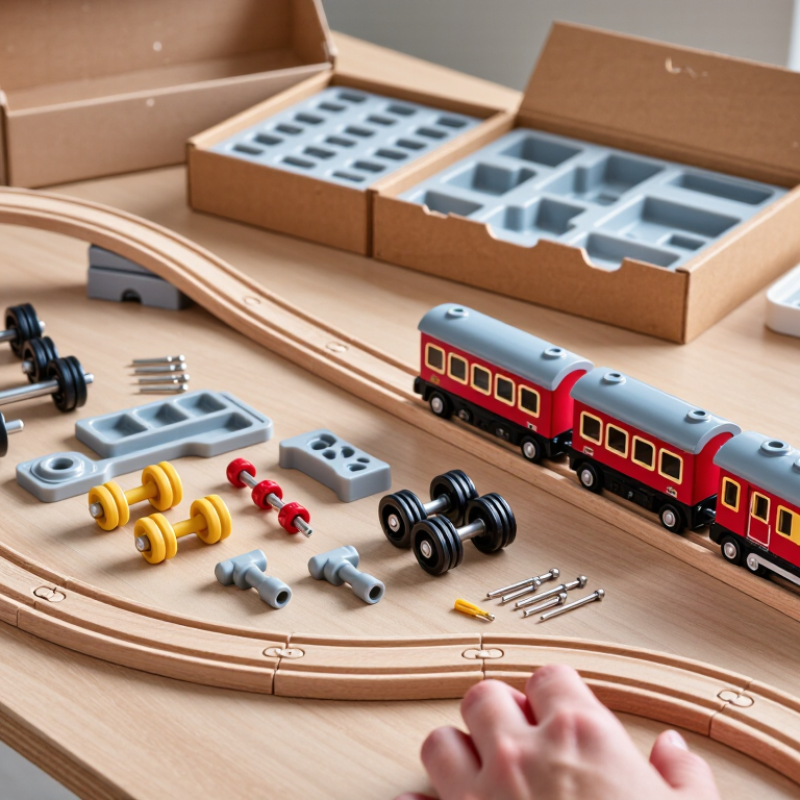
China Best Free Wheel Railway Set Supplier?

What Is a Free Wheel Railway Set and How Does It Work?

China Best Free Wheel Railway Set Supplier?

What Is a Free Wheel Railway Set and How Does It Work?

A free wheel railway set is a toy train system whose cars roll without onboard motor power. A child pushes the train, or a gentle slope starts it moving. The wheels turn on axles, and low friction lets the cars coast along the track. The exact meaning can vary by product, so check whether the locomotive is also unpowered.

On a smooth track, the train gains momentum from a push and gradually slows as friction and track joints resist movement. Curves, uneven connections, and loose axles can cause stalling or derailment. Small details matter. Check that wheels sit squarely on the rails and couplings move freely. A simple hand-push test on level track can reveal binding before play begins.

For context, the International Energy Agency’s 2019 report, The Future of Rail, estimates that rail carries about 8% of global passenger transport and 7% of freight, while using roughly 2% of transport energy. Those figures describe full-scale rail, not toy performance. Still, they show why rolling resistance matters in rail design. A free-wheel toy is much simpler, and its performance depends heavily on track quality and careful assembly.

Main Components and Common Railway Applications

A railway wheelset typically consists of two steel wheels mounted on a common axle. Bearings and axleboxes support the axle and transfer loads to the bogie. Seals and lubrication help keep dust and water away from the bearings.

Small details matter. Wheel profile, axle dimensions, and bearing capacity must suit the vehicle and track. A mismatch can increase wear, vibration, or inspection needs. It is easy to focus on the wheels and overlook the axlebox.

These assemblies serve freight wagons, passenger coaches, locomotives, and urban rail vehicles. Freight service demands attention to axle loads and long duty cycles; passenger service also prioritizes smooth running and noise control. In metros, frequent stops make inspection and maintenance planning important.

The International Energy Agency’s Future of Rail report (2019) estimates that rail carries 8% of global passenger transport and 7% of freight, while using 2% of transport energy.

Those broad figures help explain rail’s reach, but they do not replace route-specific engineering data. Supplier comparisons should therefore check drawings, material traceability, test records, and compatibility with the intended bogie.

One limitation remains: published market figures rarely describe component failure rates in enough detail.

Quality Standards for Free Wheel Railway Sets in China

For railway wheelsets, quality begins with controlled dimensions and traceable materials. A Chinese supplier should provide material certificates, heat-treatment records, and inspection results tied to each axle and wheel. For export projects, buyers can specify relevant requirements from EN 13260 for wheelsets, EN 13261 for axles, and EN 13262 for wheels. These standards do not replace project-specific acceptance criteria. Check wheel profile measurements, axle geometry, press-fit records, and ultrasonic inspection reports. Numbers matter. So does evidence.

Inspection needs to follow the component through production, not stop at final assembly. Request calibration records for measuring equipment and review how nonconforming parts are isolated and corrected. China State Railway Group reported 4.08 billion passenger trips in 2024; that scale makes consistent maintenance and component traceability especially important. It is useful context, not proof that any supplier’s wheelsets will perform well. A certificate alone cannot show field life. Ask for batch-level records and clarify how inspection findings are retained. One weak point remains: paperwork may look complete while measurement methods vary between shifts. Buyers should verify sample records and witness critical checks before approving a production batch.

China Best Free Wheel Railway Set Supplier? – Quality Standards for Free Wheel Railway Sets in China

Quality Dimension What to Verify Evidence or Inspection Method Acceptance Basis
Applicable specifications Confirm the wheelset type, vehicle application, operating conditions, and the standards required by the project. Review the purchase specification, approved drawings, and applicable standard editions before production. Contract requirements and the standards explicitly adopted for the order.
Wheel material and manufacture Check material identification, manufacturing records, and required mechanical properties for the specified wheel type. Review material certificates, heat or batch records, and test reports. GB/T 12814 may apply to railway vehicle wheels. Applicable product standard and approved technical specification.
Axle material and manufacture Verify axle material, manufacturing route, identification, and specified mechanical properties. Review material certificates, process records, and test reports. GB/T 12813 may apply to railway vehicle axles. Applicable product standard and approved technical specification.
Dimensions and profile Inspect wheel diameter, back-to-back distance, wheel profile, axle dimensions, and other drawing-defined features. Use calibrated gauges and measuring equipment; retain inspection records linked to the wheelset identification. Approved drawings and specified tolerances.
Heat treatment and hardness Confirm the specified heat-treatment process and required hardness characteristics for the wheel and axle. Review heat-treatment charts and hardness test results; check test locations and methods against the specification. Product standard, approved process, and contract requirements.
Surface and internal integrity Check for unacceptable surface defects and internal discontinuities in areas requiring examination. Use visual inspection and the specified non-destructive testing methods, such as ultrasonic or magnetic-particle testing where required. Specified inspection coverage, procedure, and acceptance criteria.
Wheelset assembly and fit Verify wheel mounting, press-fit records where applicable, component orientation, and assembly condition. Review assembly procedures, recorded fitting parameters, and final inspection results. Approved assembly drawings and process requirements.
Runout and rotational checks Check the assembled wheelset for specified runout, concentricity, and smooth rotation. Measure on suitable inspection equipment and record results for each wheelset. Drawing tolerances and the applicable vehicle or component specification.
Traceability and documentation Ensure wheels, axles, and completed assemblies can be traced to their material batches and inspection records. Check permanent markings, serial or batch identifiers, certificates, and the final inspection dossier. Contractual traceability and documentation requirements.
Packaging and delivery condition Confirm protection against corrosion, impact, contamination, and handling damage during storage and transport. Inspect packaging, preservation measures, identification labels, and shipping records before dispatch. Approved packaging specification and transport requirements.

Note: “Free wheel railway set” can refer to different products or configurations. Confirm the intended component, vehicle application, applicable standard editions, inspection scope, and acceptance limits in the contract before placing an order. Listed Chinese standards should be checked for applicability to the specific project.

How to Evaluate Chinese Railway Set Suppliers

China Best Free Wheel Railway Set Supplier?

How to Evaluate Chinese Railway Set Suppliers

Choosing a railway set supplier takes more than comparing quotations. Start with the exact wheel, axle, gauge, load, and operating conditions your project requires. “Free wheel” can mean different configurations, so ask the supplier to confirm the design in a drawing. Check material specifications, dimensional tolerances, and inspection methods. A clear answer matters.

Request sample parts and inspect them against agreed measurements. Ask how production batches are checked, how defects are recorded, and whether material and inspection documents can be provided. Confirm lead times, packaging, and how design changes are approved. A polished catalogue is not proof of consistent production. No review catches everything; a sample may fit well while a later batch reveals an issue. Build verification into the order, and keep written records of approved specifications.

Tips: Send a simple drawing with key dimensions marked. Compare supplier responses, not just prices. Ask for recent inspection records, then verify critical measurements on arrival. If an answer is vague, pause and clarify it. Small gaps can become expensive delays.

Supplier Verification, Customization, and After-Sales Support

Choosing a free wheel railway set supplier starts with evidence, not a polished catalogue. Request material certificates, heat-treatment records, inspection results, and traceability from raw stock to finished assembly. Check critical dimensions, wheel runout, hardness, and non-destructive testing against your drawings and operating conditions. The UNIFE World Rail Market Study 2024 estimates the global rail supply market averaged about €201 billion annually in 2021–2023. That scale makes supplier quality systems and documented control especially important.

Customization should be specific. Share axle loads, track conditions, duty cycles, interfaces, and expected service life. Ask for a drawing review, tolerance table, and prototype inspection plan before approving production. A supplier should explain what can change safely, and what cannot. Small details matter: a mismatched interface can delay installation, while unclear tolerances can complicate maintenance. I would still question any schedule that promises customization without design review; speed alone proves little.

After-sales support needs named technical contacts, spare-part availability, response targets, and a clear warranty process. Request sample inspection reports and references for comparable railway applications, then verify them independently. Agree how defects are logged and how corrective actions are tracked. Not glamorous, but useful. Supplier verification is not a one-time paperwork exercise; production changes and replacement parts can quietly weaken earlier controls.

Stay in touch with the latest National Luna Products and News!