How to Choose a Turbine Generator for WTE?
Choosing a Turbine Generator For Wte requires more than comparing nameplate capacity. Waste composition changes daily. Moisture, chloride levels, and seasonal heating demand directly affect steam quality and turbine reliability.
The World Bank’s What a Waste 2.0 report estimates that global municipal solid waste reached 2.01 billion tonnes annually. It could reach 3.40 billion tonnes by 2050. This growth increases demand for dependable energy recovery. However, waste is not a consistent fuel. The European Commission’s 2019 Best Available Techniques Reference Document for Waste Incineration highlights corrosion control, energy efficiency, and emissions management. These factors should guide turbine selection.
Small details matter.
A suitable turbine must match steam pressure, temperature, flow variation, and condenser conditions. Extraction options may support district heating or industrial users. Air-cooled condensers can reduce water demand, but they may lower output during hot weather. The U.S. EPA also identifies energy recovery as part of an integrated materials management strategy, not a replacement for recycling.
Professor Nickolas Themelis, founder of the Earth Engineering Center’s WTERT program, stated, “Waste-to-energy is a component of an integrated waste management system.” His point remains practical. A turbine cannot correct poor waste preparation, unstable boiler operation, or weak maintenance planning.
There is no universal best model.
Operators should review proven references, blade materials, startup performance, vibration monitoring, and local service support. A cheaper generator may create expensive downtime. That risk is easy to underestimate. Yet even experienced engineers can misjudge future waste quality, so selection should include sensitivity testing and honest operational assumptions.
Understanding WTE Turbine Generator Operating Principles
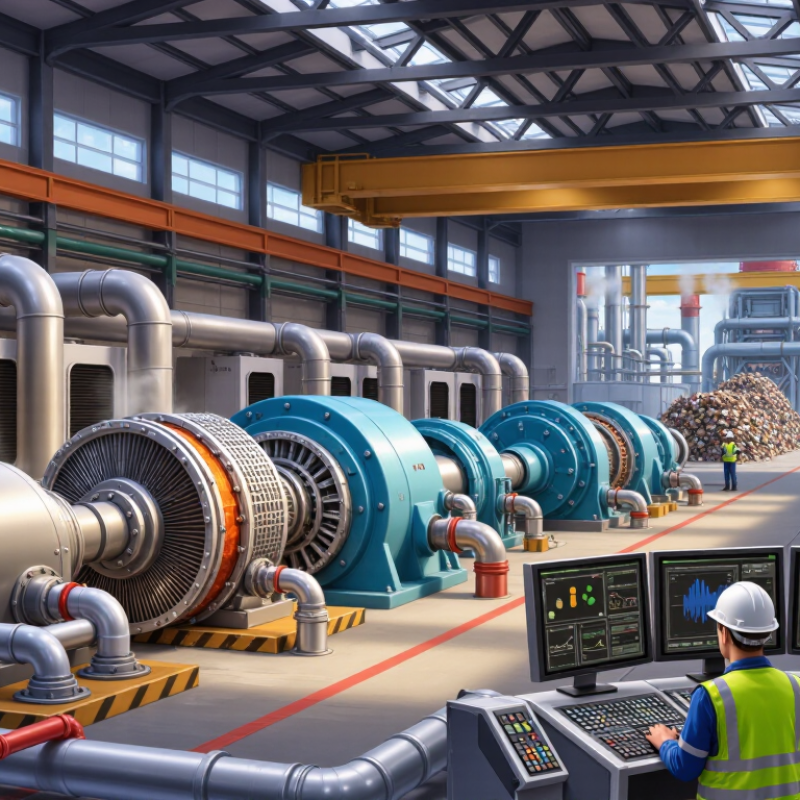
Choosing a turbine generator for waste-to-energy starts with understanding the steam path. A boiler converts recovered heat into high-pressure steam. The steam enters turbine nozzles and accelerates across rotating blades. This pressure drop becomes shaft torque, which drives the generator rotor. The generator then converts mechanical rotation into electrical power. Simple in theory. Not always in practice.
As steam expands, temperature and pressure fall through several stages. Each stage extracts energy while controlling velocity and moisture. Excess moisture can erode the final blades. A condenser lowers exhaust pressure, increasing turbine expansion and output. Feedwater pumps return condensate to the boiler circuit. In operating plants, key readings include steam pressure, vibration, bearing temperature, exhaust vacuum, and generator frequency. These signals reveal problems before production losses become obvious. Instruments can drift, so calibration records matter.
Selection should match waste composition, boiler stability, steam flow, and grid requirements. A unit designed for steady steam may perform poorly under fluctuating waste loads. Check inlet pressure, exhaust arrangement, speed, extraction needs, and annual operating hours. Request verified performance data at partial load, not only peak conditions. Cooling capacity and water quality also affect reliability. Field reviews sometimes show reasonable assumptions failing during wet-season cooling conditions. That lesson is uncomfortable but useful. Conservative margins may cost more upfront, while insufficient margins can shorten service life.
Assessing Waste Fuel Characteristics and Energy Output
How to Choose a Turbine Generator for WTE?
Waste-to-energy projects begin with the fuel, not the turbine. Municipal waste changes daily. Moisture, ash, plastics, food residues, and seasonal materials affect its heating value. Measure these properties through representative sampling, laboratory testing, and long-term records. One truckload proves little.
A useful assessment includes lower heating value, moisture content, ash percentage, chlorine, sulfur, and particle size. Wet waste can reduce steam production and destabilize combustion. High ash may increase fouling, erosion, and maintenance intervals. Chlorine also deserves close attention because it can accelerate high-temperature corrosion. These risks influence boiler pressure, steam temperature, and turbine material selection.
Estimate energy output from the realistic fuel range, not the best test result. A practical model should include boiler efficiency, turbine efficiency, generator losses, parasitic loads, and planned downtime. For example, a facility receiving 20 tonnes per hour may produce different power outputs. The difference between 8 and 12 MJ per kilogram can be substantial. The grid connection and export limits matter too.
Keep assumptions visible. That helps engineers challenge weak inputs. It also improves financing decisions. In practice, operators often overestimate annual availability during early planning. The correction can be uncomfortable. Still, a slightly conservative turbine usually performs better than an oversized unit running below design conditions. Review seasonal fuel data, emissions controls, cooling conditions, and future waste changes before selecting the final generator.
Matching Turbine Design to Steam Conditions and Plant Scale
How to Choose a Turbine Generator for WTE?
Matching Turbine Design to Steam Conditions and Plant Scale
A waste-to-energy turbine must match the boiler, not just the electrical target. The European Commission’s 2019 Best Available Techniques Reference Document reports typical waste-incineration steam conditions near 40–60 bar and 400–450°C. These temperatures improve efficiency, but corrosive ash can shorten superheater life. A practical design leaves operating margin.
Start with the steam flow curve. A small plant may need a compact condensing turbine with simple controls. Larger facilities often benefit from extraction-condensing equipment, especially when district heating or process steam has local demand. The World Bank’s What a Waste 2.0 estimates global municipal waste could rise from 2.01 billion tonnes in 2016 to 3.40 billion tonnes by 2050. Waste volumes are growing, but they are rarely steady.
That matters.
Waste composition changes with moisture, plastics, and seasonal habits. A turbine sized for peak steam flow may run inefficiently during low-load periods. The U.S. Energy Information Administration has cited roughly 550 kWh of electricity per ton of municipal waste as a typical recovery figure. This is a useful benchmark, not a guarantee. Site measurements should replace assumptions.
Reviewers should compare annual operating hours, minimum stable load, exhaust pressure, and maintenance access.
A turbine that looks efficient on a design sheet may perform poorly with wet waste and frequent starts.
I would also question overly optimistic availability claims. Real plants are less tidy.
Comparing Efficiency, Reliability, Maintenance, and Safety
Choosing a turbine generator for waste-to-energy requires more than reading its rated output. Efficiency depends on the steam cycle, waste quality, and operating load. A turbine designed for stable steam may perform poorly when boiler pressure fluctuates. Check electrical efficiency at realistic conditions, not only at the best test point. Heat balance calculations should include seasonal waste changes and auxiliary power consumption.
Reliability is equally important. Examine vibration limits, rotor design, control-system response, and tolerance to wet steam. Corrosive compounds can damage blades and condensers, especially when flue-gas treatment is inconsistent. Maintenance access matters, too. Engineers should verify inspection intervals, lifting space, bearing replacement methods, and spare-part availability. A small efficiency gain may not justify long outages or difficult repairs. No turbine wins every category.
Tips: Compare at least three operating scenarios. Request performance curves, maintenance records, and independent inspection results. Confirm overspeed protection, emergency shutdowns, pressure relief devices, and safe isolation procedures. Train operators with realistic fault simulations. Keep water chemistry under strict control. Small neglect becomes expensive.
Safety should remain visible during daily operation, not only during commissioning. Guards, interlocks, noise controls, and clear escape routes reduce practical risk. Review the complete steam and electrical system, including grid protection and backup power. Standards and local requirements must be checked by qualified professionals. One imperfect assumption can undermine an otherwise excellent design. A documented risk review often reveals weaknesses that efficiency spreadsheets miss.
How to Choose a Turbine Generator for WTE?
Comparison of typical engineering benchmarks for waste-to-energy turbine-generator technologies.
Condensing steam turbines generally provide the highest electrical output from WTE steam, while back-pressure units can offer strong availability when useful process heat is required. ORC systems typically operate at lower efficiency but may reduce maintenance demands because they use a closed organic working-fluid cycle and lower operating pressures. Actual performance depends on steam conditions, waste composition, plant scale, operating strategy, and maintenance quality.