7 Tips for Buying a Hybrid Grid Tie Inverter

Choosing a Hybrid Grid Tie Inverter is not simply a matter of comparing wattage and price. It affects solar production, battery charging, grid interaction, and household safety. A model that looks excellent online may perform poorly in a hot garage or during unstable voltage conditions. Real installation details matter.

This guide introduces seven practical tips for making a more confident decision. It considers inverter efficiency, battery compatibility, backup output, monitoring functions, warranty coverage, safety certifications, and future expansion. Check the data sheet carefully. Look for clear information about maximum photovoltaic input, continuous output power, surge capacity, and operating temperature. These figures often reveal more than advertising language.

Experience also shows that system compatibility is frequently underestimated. A battery may use the correct voltage but still require specific communication protocols. A qualified installer should confirm wiring requirements, protection devices, and local grid connection rules before purchase. Do not rely only on a sales representative’s promise. Ask for written specifications.

Small details matter.

For example, a noisy cooling fan can become frustrating beside a living area. A weak mobile application may make fault diagnosis unnecessarily difficult. An attractive warranty may exclude batteries, labor, or weather-related damage. These are easy points to miss. I have also seen buyers choose oversized equipment, expecting better performance, while their panels could not provide enough energy to use it effectively. More capacity is not always more value.

The following tips aim to balance technical performance, installation reality, long-term reliability, and personal energy needs. No checklist is perfect. Still, careful questions can prevent expensive surprises.
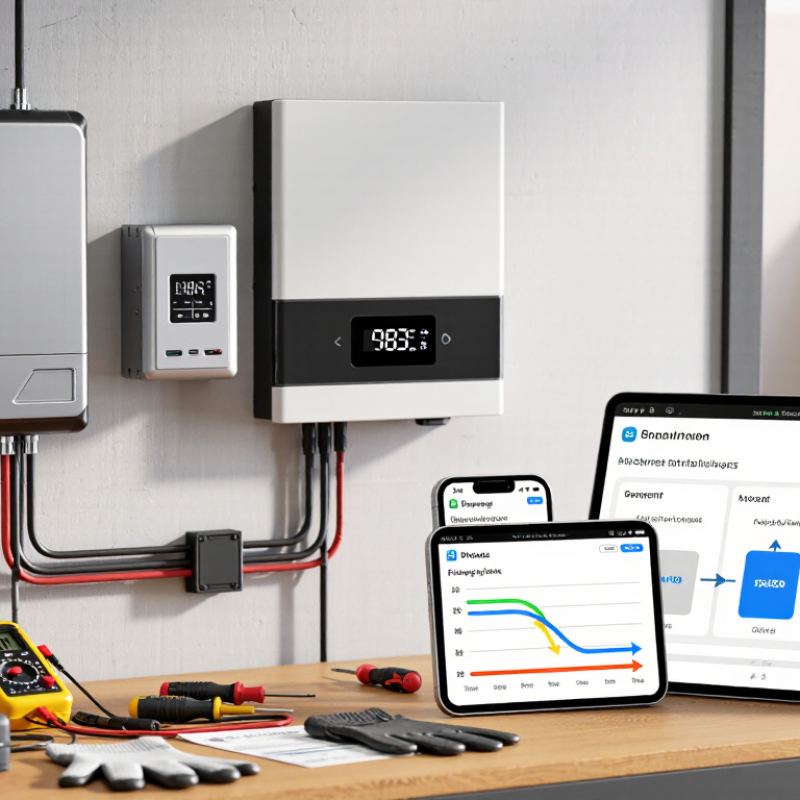
7 Tips for Buying a Hybrid Grid Tie Inverter

Define Hybrid Grid-Tie Inverters and the Seven Core Buying Criteria

7 Tips for Buying a Hybrid Grid Tie Inverter

Define Hybrid Grid-Tie Inverters and the Seven Core Buying Criteria

A hybrid grid-tie inverter connects solar panels, batteries, household loads, and the utility grid. Unlike a basic grid-tied inverter, it stores surplus electricity for later use. During an outage, approved backup circuits may remain powered. Local grid rules and anti-islanding controls still apply. IRENA’s Renewable Capacity Statistics 2024 recorded approximately 345 GW of new solar PV capacity worldwide in 2023. The IEA’s Renewables 2024 report also found solar provided roughly three-quarters of renewable capacity expansion that year. Market growth makes careful selection increasingly important.

Check seven core criteria: continuous AC output, battery compatibility, MPPT voltage range, conversion efficiency, backup transfer time, grid certification, and monitoring quality. Size continuous output for real loads, not optimistic appliance labels. Confirm battery voltage and chemistry requirements before purchasing. A wider MPPT window can help on cloudy mornings or partially shaded roofs. Efficiency matters, but published peak efficiency may not reflect everyday performance. Look for clear islanding protection and certification for your local grid. Monitoring should show power flow, battery state, faults, and historical data.

Service quality matters too. Read the warranty conditions carefully. Installation support can be more valuable than a slightly higher efficiency rating. No checklist is perfect. I would not trust attractive app screenshots alone. Heat, dust, poor ventilation, and software updates can change actual performance. The U.S. Department of Energy recommends evaluating system design, safety, and long-term operating conditions rather than comparing one headline specification.

Match PV, Load, and Battery Ratings for 95–98% Peak Efficiency

Buying a hybrid grid-tie inverter starts with matching three ratings: PV input, household load, and battery power. A 10 kW solar array should not automatically use a 10 kW inverter. Check the inverter’s maximum DC voltage, MPPT current, and recommended oversizing ratio. Fraunhofer ISE’s Photovoltaics Report 2024 records peak inverter efficiencies above 98% for many current systems. Real performance is lower. Peak is not average.

For 95–98% peak efficiency, keep the PV array near the inverter’s practical operating window. Leave enough headroom for cold-weather voltage rises. Size continuous output above the home’s measured peak load, not its estimated average. Include starting surges from pumps, refrigerators, and compressors.

Battery voltage must match the inverter’s permitted range. Battery charge and discharge current should also support the inverter’s rated power. Small mismatch matters.

IEA PVPS Task 13 highlights temperature, shading, wiring, and conversion losses as major causes of lower delivered energy. The U.S. Department of Energy’s Energy Storage Grand Challenge Roadmap commonly places battery round-trip efficiency around 85–90%, depending on chemistry and operating conditions. Ask for weighted efficiency, standby consumption, overload duration, and tested temperature limits.

I have seen projects chase a higher peak number while ignoring nighttime losses. That choice needs reconsideration. Measure twice. Then compare the datasheet with twelve months of actual load data.

Check Battery Compatibility, 80–90% DoD, and 4,000+ Cycle Life

Buying a hybrid grid-tie inverter requires more than checking its wattage. Battery compatibility is the practical starting point. Confirm voltage range, chemistry settings, communication protocols, and charging limits. A lithium iron phosphate battery may require different parameters than a lead-acid battery. The U.S. Department of Energy’s 2022 Energy Storage Technology and Cost Characterization Report shows that cycle life varies widely with chemistry, temperature, and operating conditions. Specifications can be optimistic.

Tip 1 Match the inverter with the battery’s nominal and maximum voltage.

Tip 2 Confirm whether the system supports 80–90% depth of discharge (DoD). Using more capacity can improve daily energy yield, but it may increase degradation.

Tip 3 Look for at least 4,000 rated cycles, while checking the test conditions. That number is meaningless without temperature, DoD, and remaining-capacity criteria.

Tip 4 Verify independent battery communication testing. Basic compatibility is not enough.

Tip 5 Check round-trip efficiency and standby consumption. Lazard’s 2024 Levelized Cost of Storage report indicates that battery-system efficiency depends on configuration, controls, and auxiliary loads.

Tip 6 Inspect backup transfer time and grid-support functions. These features matter during short outages.

Tip 7 Review warranty exclusions, especially heat, poor ventilation, and repeated full discharges. I once treated a cycle-life figure as a guarantee; that was careless. Real homes rarely follow laboratory schedules. Leave ventilation space, log monthly performance, and question unusually perfect claims.

Verify IEEE 1547-2018, UL 1741 SB, and Anti-Islanding Protection

Buying a hybrid grid-tie inverter requires more than checking efficiency. IEA PVPS reported about 447 GW of new solar capacity worldwide in 2023, increasing pressure on distribution grids.

Tip 1: Request certification for IEEE 1547-2018 and UL 1741 SB.

Tip 2: Confirm the certificate covers the exact inverter model and firmware. A family certificate may not cover every revision.

Tip 3: Ask for laboratory test records, not only a printed compliance logo.

Tip 4: Examine anti-islanding protection under abnormal voltage and frequency conditions. The inverter should disconnect quickly when grid power disappears, then reconnect only within approved limits.

Tip 5: Verify selectable grid profiles for your utility. Incorrect ride-through settings can create delays, nuisance trips, or unsafe operation.

Tip 6: Confirm whether export limits, reactive-power control, and battery charging behavior meet local interconnection requirements. IEEE 1547-2018 addresses these functions, but field settings still matter.

Tip 7: Inspect monitoring and event logs before purchase. A clear timestamped record can reveal repeated trips, firmware problems, or unstable voltage.

The U.S. National Renewable Energy Laboratory’s photovoltaic cost and performance reports show that system value depends on reliable operation, not efficiency alone.

I once underestimated documentation quality; that was a mistake.

Ask who updates firmware, who performs commissioning, and who supports troubleshooting. Standards reduce risk, but careful verification closes the gap.

Compare Backup Transfer, Surge Capacity, Monitoring, Warranty, and Total Cost

7 Tips for Buying a Hybrid Grid Tie Inverter

Tip 1: Check backup transfer time. A fast transfer, often below 20 milliseconds, can keep sensitive routers and medical equipment running. However, published figures may apply only under specific wiring conditions. Ask for test standards, not marketing claims. Tip 2: Measure surge capacity carefully. Refrigerators, pumps, and compressors can demand three times their running power during startup. Select an inverter that lists both continuous and peak output.

Tip 3: Review monitoring details. A useful app should show solar production, battery state, grid flow, and fault history. The International Energy Agency reported that solar capacity formed about three-quarters of global renewable additions in 2023. More solar also means more data to manage. Tip 4: Examine battery compatibility and efficiency. NREL’s 2024 Annual Technology Baseline uses approximately 85% round-trip efficiency for many battery-storage models. Real household results can be lower. Cable length, temperature, and standby consumption matter.

Tip 5: Read the warranty line by line. Check coverage for fans, screens, communications hardware, and labor. Tip 6: Calculate total cost. Include installation, transfer equipment, monitoring fees, battery replacements, and possible service visits. A lower purchase price may become expensive after five years. Tip 7: Request independent test evidence. Certification to applicable grid-interconnection standards supports safer planning, but it does not guarantee perfect backup performance. I would also test the system during daylight and at night. That small step can expose confusing settings before an actual outage.

Stay in touch with the latest National Luna Products and News!