What Is a Wooden Mechanical Vehicle Model?
A Wooden Mechanical Vehicle Model is a buildable object that combines timber, gears, axles, and moving joints. It may resemble a car, truck, tractor, or construction machine. Unlike a static ornament, it demonstrates motion through hand-powered mechanisms. Turning one small crank can rotate several wooden gears. The movement is visible, audible, and easy to inspect.
This category sits between traditional craftsmanship, educational play, and the wider construction-toy market. Grand View Research estimated the global toys market at approximately USD 108.7 billion in 2023, with continued growth expected through 2030. Its market analysis also highlights rising interest in educational and STEM-focused products. The Toy Association has repeatedly identified hands-on learning and screen-free play as important consumer interests. These reports do not isolate wooden mechanical vehicles, however. The category remains poorly standardized.
That gap matters. A reliable Wooden Mechanical Vehicle Model needs accurate cutting, smooth axle holes, stable wood, and safe surface finishing. ASTM F963 and EN 71 provide useful reference points for toy safety, especially regarding small parts, sharp edges, and materials. Manufacturers should verify applicable requirements in their target markets. A loose gear can stop the vehicle. A rough edge can damage a child’s hand. Small flaws become obvious during assembly.
The appeal is practical, not merely nostalgic. Builders learn basic transmission, friction, balance, and tolerance by touching every component. Still, wooden mechanisms are not automatically sustainable or educational. Wood sourcing, packaging, durability, and repairability require honest evaluation. The following sections examine how these models work, why people build them, and where their limitations deserve closer attention.
Definition and Core Characteristics of a Wooden Mechanical Vehicle Model
What Is a Wooden Mechanical Vehicle Model?
Definition and Core Characteristics of a Wooden Mechanical Vehicle Model
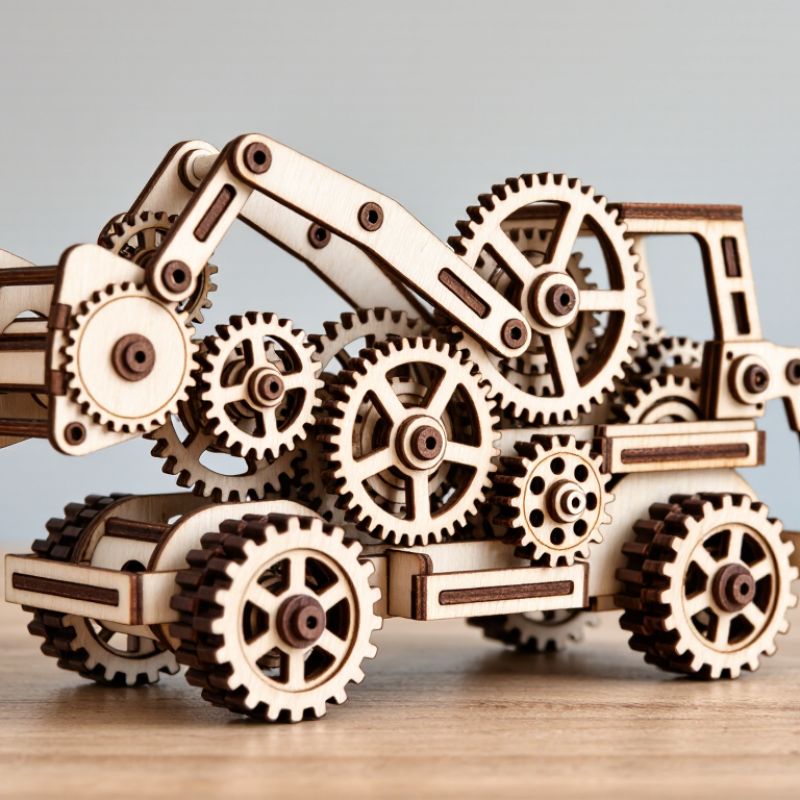
A wooden mechanical vehicle model is a scaled vehicle built mainly from wood and designed to demonstrate movement. Unlike a static ornament, it usually contains working parts such as gears, axles, levers, cams, or wheels. Hand pressure, a winding mechanism, or gravity may provide the motion. Its purpose is not only appearance. It shows how mechanical force travels through connected components.
The core characteristic is visible mechanical action. When a wooden gear turns, its teeth transfer movement to another gear. An axle then rotates the wheels, while carefully placed supports reduce unwanted friction. Good models use clean cuts, balanced wheels, and holes aligned with precision. Wood grain matters too. A soft section may split, while a warped piece can disturb the entire mechanism. Small differences become obvious during testing.
Practical assembly often reveals more than the instructions suggest. A wheel may wobble slightly. A gear may need gentle sanding. That is normal, but it should not be ignored. A reliable model moves steadily, uses safe materials, and withstands repeated handling without loose parts. It also invites inspection, because each mechanism remains visible. Still, calling it a perfect machine would be misleading. Wooden parts change with moisture, and handmade tolerances are rarely exact. That imperfection creates a useful lesson: mechanical design depends on patience, measurement, and continuous adjustment.
Historical Development and Cultural Significance
What Is a Wooden Mechanical Vehicle Model?
A wooden mechanical vehicle model is more than a small decorative object. It combines carved parts, axles, gears, and controlled movement. Early versions developed from handmade toys, workshop demonstrations, and educational devices. Craftspeople often used local hardwood, simple pegs, and vegetable-based finishes. A child could turn one wheel and watch another rotate. That visible motion made mechanical principles easier to understand.
Its cultural meaning changed across time. During the Industrial Revolution, miniature wagons, trains, and engines reflected society’s fascination with transport and manufacturing. In many communities, these models also preserved local skills. A carved truck could represent a regional trade route, while a wooden bus might recall daily urban life. The details matter: uneven wheel marks, tight joints, and a faint smell of oil suggest human labor. Not everything was perfectly engineered. That imperfection is part of the story.
Modern interest also connects with the wider educational toy sector. Grand View Research valued the global toys market at about 108.7 billion dollars in 2023, with continued growth projected through 2030. The IMARC Group likewise identifies learning-focused toys as a significant market segment in its 2024 industry analysis. These figures do not measure wooden mechanical vehicles directly, so applying them too broadly would be careless. Still, they show growing demand for tactile learning and durable play. Museums, schools, and collectors now treat these models as cultural evidence, not merely souvenirs. A wooden vehicle can preserve engineering knowledge, family memory, and changing ideas about progress.
Mechanical Principles Behind Its Moving Components
A wooden mechanical vehicle model moves through stored energy, controlled friction, and carefully timed motion. A hand-turned crank transfers torque to the drive axle through gears. Smaller gears increase speed, while larger gears increase turning force. The relationship is simple: gear ratio equals driven teeth divided by driving teeth. A 3:1 ratio gives stronger rotation but slower wheel movement.
Cams and linkages create more visible action. An oval cam can lift a suspension arm, then release it as the axle turns. Connecting rods convert circular motion into a repeated steering or piston movement.
The U.S. Department of Energy’s 2023 Vehicle Technologies Office report notes that advanced electric-drive systems can exceed 90% peak efficiency. A wooden model performs far below that level because its joints rub, surfaces flex, and hand-cut teeth rarely align perfectly. That weakness becomes part of the lesson.
A small amount of graphite may reduce friction, but excessive lubrication can collect dust. I have found that a loose axle often matters more than a poorly shaped wheel.
Wood also changes with humidity. Engineering guidance from the Forest Products Laboratory reports that wood dimensions vary as moisture content changes. Therefore, a tight gear mesh may work in one room and bind in another. Leave slight clearance. The model may wobble. That wobble exposes the real principle: motion depends on tolerance, load, friction, and timing working together.
Common Materials, Designs, and Construction Methods
What Is a Wooden Mechanical Vehicle Model?
Common Materials, Designs, and Construction Methods
A wooden mechanical vehicle model combines decorative craft with moving engineering. Common materials include basswood, plywood, bamboo, and hardwood dowels. Basswood cuts easily, while plywood resists bending around the chassis. Small metal pins can strengthen axles, although an all-wood design feels more authentic.
Popular designs include cars, tractors, walking vehicles, and crank-driven wagons. Gears transfer motion, cams create lifting actions, and linkages control wheels or legs. A working model needs accurate spacing. Even a one-millimeter error can cause rubbing or uneven movement. I usually test each axle before attaching the body. My first chassis looked attractive but twisted under pressure. That mistake taught me to measure both sides repeatedly.
Construction methods vary with the desired detail. Hand tools provide control around thin parts, while precision cutting creates cleaner repeated shapes. Sanding the axle holes gradually helps prevent loose movement. Wood glue should be applied sparingly. Excess glue can block gears and spoil visible joints. A practical builder also checks grain direction before cutting. Decorative panels may hide joints, but they should not hide poor alignment.
Tips: Keep a simple paper template nearby. Test the mechanism without paint. Leave tiny clearance between moving parts. Record failed adjustments; they often reveal the real design problem.
Wooden Mechanical Vehicle Models: Common Wood Densities
Approximate air-dry density affects how a wooden mechanical vehicle model performs. Lightweight basswood is easy to cut and suitable for small gears and body panels, while denser birch, beech, and oak provide greater strength for axles, frames, and load-bearing components. Pine offers a practical balance between weight, availability, and workability. Actual density varies with species, moisture content, and grain structure.
Uses, Educational Value, and Collecting Considerations
A wooden mechanical vehicle model is a small vehicle built from shaped wood and working parts. Wheels, axles, gears, or levers may create simple movement. Unlike a plastic toy, it shows how material, friction, and balance affect performance.
These models support hands-on learning. While assembling one, a learner can observe how a gear transfers motion. Measuring pieces also builds patience and basic spatial reasoning. I have found that loose joints often teach more than perfect results. They reveal alignment problems clearly. The process can introduce engineering ideas without requiring advanced equipment. However, instructions are not always flawless. Builders should question unclear steps and test each movement gently.
Collectors usually examine wood quality, joint strength, surface condition, and mechanical completeness. Look for cracks around axles and signs of excessive moisture. A clean finish is attractive, but it may hide repairs. Original packaging or assembly notes can improve an item’s history, though paperwork does not guarantee authenticity. A higher price does not prove rarity. Display models need stable shelves, moderate humidity, and protection from direct sunlight. Some pieces are better handled occasionally, while others should remain display objects. Storage decisions can be surprisingly difficult. A model may be valuable emotionally, even when its market value remains modest.