Choosing a dual battery kit is not simply a matter of adding more power. It is a decision about vehicle fit, electrical demand, climate, driving habits, and long-term reliability. A touring vehicle may need energy for a refrigerator, lights, communication equipment, or recovery tools. A work truck may require a different arrangement. The right solution starts with real usage, not impressive packaging.
Global buyers face extra questions. Battery chemistry, capacity, charging method, cable length, fuse placement, and isolator design can vary widely. A kit that performs well in a dry workshop may struggle in heavy rain, desert heat, or freezing conditions. Check the vehicle model carefully. Confirm available mounting space. Measure the cable route before ordering. Small oversights can create expensive delays.
This guide shares ten practical tips based on common installation challenges and professional electrical principles. It considers compatibility, safe current handling, battery monitoring, ventilation, maintenance, and supplier support. Manufacturer specifications matter. So do clear wiring diagrams and honest technical advice. Some recommendations may not fit every vehicle. That is worth admitting. A premium kit cannot repair poor grounding or careless installation. Buyers should compare verified data, inspect included components, and ask qualified technicians when uncertainty remains. Reliable performance comes from a complete system, not one attractive component. Take your time. Power problems rarely announce themselves politely.
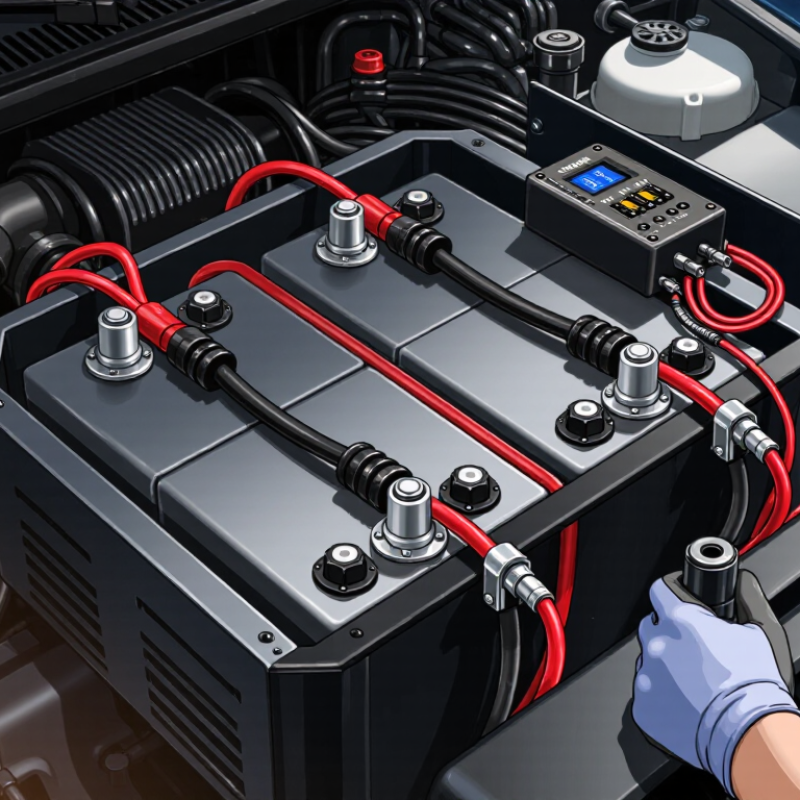
Choosing between AGM and LiFePO₄ changes how a 12-volt dual battery kit should be designed. AGM batteries are sealed, vibration-resistant, and relatively simple to install. They suit occasional camping, emergency equipment, and vehicles with conservative charging systems. However, they are heavy and deliver less usable capacity as voltage falls.
LiFePO₄ batteries usually provide a steadier 12.8-volt output and much higher usable capacity. A smaller lithium battery can replace a larger AGM unit, saving valuable space and weight. Its battery management system should protect against overcharge, deep discharge, excessive current, and low-temperature charging. That last point matters in cold regions. Charging lithium cells below freezing can cause permanent damage.
Check the charging profile, not only the battery label. Some alternators need a DC-to-DC charger for stable lithium charging. An AGM setup may tolerate simpler charging, but it still needs correct voltage control and suitable cable protection. Fuse each major positive connection close to the battery. Keep cables short, properly sized, and protected from heat and sharp metal.
Real vehicle testing can reveal problems that product sheets miss. Voltage drop may appear after a long cable run. A battery may also fit physically but fail under high accessory loads. I have seen planning focus too much on amp-hours and too little on temperature, charging time, and service access. That is an easy mistake. Global buyers should verify local support, charger compatibility, and regional installation requirements before ordering.
10 Dual Battery Kit Tips for Global Buyers
Calculate auxiliary capacity using amp-hours, not only battery size. A battery rated at 100 Ah does not provide 100 usable amp-hours when it uses lead-acid chemistry. A practical 50% depth-of-discharge limit leaves about 50 Ah for regular use. I learned this after a fridge stopped overnight during a remote field test. My first estimate was too optimistic.
List each load and its running current. Then multiply amps by operating hours. For example, a 4-amp refrigerator running for eight hours consumes 32 Ah. Add 6 Ah for lights and 10 Ah for communications equipment. The daily demand becomes 48 Ah. At 50% lead-acid DoD, divide 48 by 0.5. You need approximately 96 Ah before adding reserve capacity. Real conditions are less tidy.
Tips: Measure actual current with a meter. Do not trust labels alone. Allow extra capacity for cold weather, aging, and cloudy charging days. A 120 Ah battery may provide less than expected when temperatures fall or charging remains incomplete. Cable length and thickness also affect performance, especially in larger vehicles. Keep the auxiliary battery ventilated and securely mounted. Check voltage after resting, not immediately after charging. That reading is more useful, though still imperfect. A modest reserve can prevent hurried decisions at night.
A dual-battery kit starts with the alternator, not the auxiliary battery. Its rated output is a ceiling, not a continuous promise. Measure charging voltage and current after a cold start, then repeat with headlights, ventilation, and heated screens operating. Modern vehicles may reduce alternator output during acceleration or regenerative braking. The IEA’s Global EV Outlook 2024 recorded almost 14 million electric-car sales in 2023, reflecting a wider shift toward electronically managed power systems. Older installation assumptions can fail here.
A battery-to-battery charger should match the alternator’s real spare capacity, battery chemistry, cable length, and fuse rating. A lower charging current is often safer than a larger advertised number. Keep cable voltage drop below the system designer’s limit, and place overcurrent protection close to each battery. Temperature sensing matters in hot engine bays. So does idle testing. A charger that performs well at highway speed may disappoint beside a campsite.
ISO 16750-2 testing should shape kit selection, especially for global buyers. The standard addresses supply interruptions, overvoltage, slow voltage changes, and electrical transients in road vehicles. Ask suppliers for test conditions, not vague “automotive grade” claims. Test the complete installation, including grounds, connectors, and fuse holders. In practice, vibration and poor crimping cause embarrassing failures. I have seen carefully sized systems lose charging through one loose earth point. That detail deserves more attention. Testing should follow the vehicle’s electrical environment, because ISO 16750 severity levels are not identical for every application.
Global dual-battery installations need more than matching battery capacity. Cable size and fuse ratings must follow ampacity, temperature, routing, and voltage-drop limits. ABYC E-11 commonly recommends a maximum 3% voltage drop for sensitive equipment and 10% for general loads. A long 12-volt run can waste useful energy quickly. Measure the complete round-trip length, not only the positive cable.
Tip 1: Calculate current before selecting cable. Use watts divided by system voltage, then add a safety margin. For example, a 600-watt inverter draws about 50 amps at 12 volts, before losses. Choose the fuse to protect the cable, not the appliance. ABYC E-11 also emphasizes overcurrent protection close to the battery source. In many installations, the protective device should be within seven inches of the battery, unless an accepted alternative method applies.
Tip 2: Check the ABYC E-11 ampacity table for engine-room temperature and bundled conductors. Heat reduces practical carrying capacity. Metric cable labels can also confuse global buyers, because cross-sectional area does not always match local naming systems. Confirm the actual conductor area and insulation rating. I have seen tidy installations fail during cranking because the cable calculation ignored return-circuit length. That mistake is easy to repeat. Recheck every connection, fuse rating, and measured voltage drop under real load, using current technical tables and the vessel’s installation requirements.
This chart presents commonly referenced allowable ampacities for copper boat cable sizes used in 12V and 24V dual-battery installations. Under ABYC E-11, select a conductor and overcurrent protective device so the fuse does not exceed the conductor's allowable ampacity. Actual sizing must also account for circuit length, voltage drop, conductor temperature rating, bundling, ambient temperature, and installation location. A fuse should be installed close to each battery's positive terminal.
When buying a dual battery kit globally, verify transport evidence before comparing capacity or price. UN 38.3 testing applies to lithium cells and batteries used in transport. It covers hazards such as altitude simulation, vibration, shock, and external short circuit.
Ask the supplier for a current UN 38.3 test summary. Check the battery model, cell type, revision date, and tested configuration. A certificate with a similar product name may not cover your exact kit. Do not rely on a shipping label alone. Customs agents and carriers may request supporting records.
IP ratings address enclosure protection under IEC 60529. An IP67 rating generally indicates dust protection and temporary water immersion resistance under defined laboratory conditions. It does not guarantee performance in salt spray, mud, pressure washing, or long-term condensation. Inspect seals, cable glands, vents, and connector covers. The weakest opening controls the practical protection level.
Review the rating for the assembled kit, not only the battery case. Ask whether testing included installed cables and mounting hardware. Transit conditions also matter. I once focused too heavily on the enclosure rating and overlooked an exposed connector. That was a useful warning. Request installation instructions, temperature limits, maintenance requirements, and destination-market documentation. Requirements can differ between the origin, transit points, and final market. Make every claim traceable to a report, drawing, or test record.
| No. | Buyer Tip | Compliance Dimension | What to Verify | Recommended Evidence | Global Buying Action |
|---|---|---|---|---|---|
| 1 | Confirm the battery chemistry | Lithium battery transport classification | Identify whether the kit contains lithium-ion, lithium-metal, or another battery type, and record the cell and battery configuration. | Product specification sheet, cell chemistry declaration, rated voltage, ampere-hour capacity, and watt-hour calculation. | Request the exact configuration intended for shipment; do not rely only on a generic product description. |
| 2 | Request a UN 38.3 test summary | UN Manual of Tests and Criteria, Part III, Sub-section 38.3 | Check that the test summary identifies the manufacturer, report or reference number, test laboratory, test date, battery type, and applicable test results. | A current UN 38.3 test summary covering the same cell or battery model and configuration being purchased. | Match model numbers, rated values, cell arrangement, and revision details before placing an order. |
| 3 | Separate cell and battery documentation | Test scope and configuration control | Determine whether the documentation covers individual cells, assembled batteries, or both. A cell report may not automatically cover a finished battery pack. | Separate technical files for cells, battery packs, battery-management systems, and any integrated charging equipment. | Ask for written confirmation that the finished dual-battery assembly is represented by the supplied compliance documents. |
| 4 | Check transport information separately | Air, sea, road, and multimodal shipping requirements | Verify watt-hours, state-of-charge requirements where applicable, packaging, marks, labels, documentation, and the shipping classification for the selected transport mode. | Dangerous-goods declaration data, packing instructions, transport classification, and carrier acceptance confirmation. | Have the freight forwarder review the shipment before dispatch, especially for batteries shipped with or contained in equipment. |
| 5 | Verify protection against short circuits | Packaging and electrical safety | Inspect terminal covers, insulating materials, cable protection, fuses, connectors, and separation between the two battery circuits. | Packaging drawings, wiring diagrams, fuse ratings, connector specifications, and pre-shipment inspection records. | Require a packing configuration that prevents movement, terminal contact, crushing, and accidental activation during handling. |
| 6 | Read the complete IP code | IEC 60529 ingress protection rating | The first digit concerns protection against solid objects and dust; the second digit concerns protection against water. Confirm the exact rating, not only the phrase “waterproof.” | IP test report or certificate stating the tested enclosure, test conditions, rating, laboratory, and report identification. | Compare the rating with the actual installation environment, including dust, rain, spray, washdown, and temporary immersion exposure. |
| 7 | Check whether the IP test covers the final assembly | Enclosure and installation integrity | Confirm that covers, cable glands, connectors, vents, mounting points, and service openings were installed as tested. | Assembly drawing, sealing specifications, installation instructions, and a report referencing the final enclosure design. | Treat field-drilled holes, replaced glands, or unsealed cable entries as potential changes to the original IP rating. |
| 8 | Evaluate temperature and moisture limits | Operating environment and battery performance | Review charge and discharge temperature limits, condensation risk, ventilation, enclosure heat, and climate conditions in the destination market. | Operating manual, thermal test data, battery-management-system limits, and environmental test information. | Specify the destination climate and duty cycle; confirm that the kit is suitable for both storage and operation. |
| 9 | Verify electrical compatibility | System integration and protection controls | Check nominal voltage, charging profile, current limits, balancing, overcharge protection, over-discharge protection, and compatibility between both batteries. | Wiring diagram, charger specifications, battery-management-system settings, load profile, and compatibility test record. | Do not connect batteries with materially different voltage, chemistry, capacity, age, or state of charge without an approved system design. |
| 10 | Build a destination-market compliance file | Import, installation, and after-sales readiness | Compile UN 38.3 documents, IP evidence, safety instructions, labels, transport records, electrical specifications, and applicable local requirements. | Controlled technical file with document revision, product identification, declarations, test reports, manuals, and inspection records. | Ask an importer, customs specialist, or qualified conformity professional to confirm requirements before commercial shipment. |
Reference note: UN 38.3 addresses the transport testing of applicable lithium cells and batteries, while IP ratings describe enclosure protection under IEC 60529. Neither document alone confirms every electrical, vehicle, radio, environmental, or market-specific requirement.
Stay in touch with the latest National Luna Products and News!